Men found guilty of Brazil activists' murder |
Two men convicted of killing environmentalists Jose Claudio da Silva and his wife Maria do Espirito Santo in 2011.
Last Modified: 04 Apr 2013 22:35
     |
| Two men have been found guilty of killing a couple who campaigned against illegal logging in the BrazilianAmazon. Jose Claudio da Silva and his wife, Maria do Espirito Santo, had for years campaigned against loggers and ranchers who force slave labour to clear-cut large swaths of the Amazon. The couple were killed in a May 2011 ambush near the Amazonian town of Maraba. Jose Rodrigues Moreira, the alleged mastermind of the attack, was found not guilty. "This is a clear defeat for the families of the victims," Al Jazeera's Gabriel Elizondo, reporting from the court, said. "There are about 100 people outside the court, family members, friends, acquaintances. They're all chanting 'justice' and 'crime'. Even though two people were found guilty, the person they wanted to go to jail was found not guilty." Rodrigues Moreira and the two alleged perpetrators, Lindonjonson Silva Rocha and Alberto Lopes do Nascimento, were arrested in a jungle hideout 300 kilometres from Maraba in the northern state of Para after the attack. The murder was the first in a series of 10 over a three-month period in the Amazon, most of them in Para, one of the Brazilian states hardest hit by violence by local loggers and ranchers against rural workers and their supporters. A report by the CPT said big land owners in the area often enjoy "total impunity". At the time of the killing of da Silva and his wife, Amnesty International, the London-based rights watchdog, had called on Brazilian authorities to end these killings as well as "the impunity enjoyed by those who incite this violence". |
Thursday, April 4, 2013
Men found guilty of Brazil activists' murder

Maduro opens campaign in Chavez's hometown
Maduro opens campaign in Chavez's hometown |
Interim leader vows to "fulfil the will and legacy" of the late president as he calls for support in the April 14 vote.
Last Modified: 03 Apr 2013 04:50
|
Maduro, centred, told his supporters he was committed to building 'socialism to its last consequences' [Reuters]
|
| Nicolas Maduro, the acting president of Venezuela, has officially opened his campaign to succeed Hugo Chavez, vowing to carry on his mentor's socialist legacy in the late leader's hometown ahead of the April 14 election. The short presidential campaign formally kicked off on Tuesday, almost one month after Chavez died in cancer on March 5. Maduro, a 50-year-old former bus driver and union leader, was accompanied by hundreds of supporters, government officials and Chavez relatives as he visited the late president's childhood home in Sabaneta, now a local ruling PSUV socialist party headquarters. "We will fulfil the will and legacy of President Chavez," the handpicked successor said, describing the house as the "cradle of the Bolivarian revolution". "We feel comandante Chavez within us, like a father. We come to make a commitment with this land that saw his birth, pledge to never fail him and build socialism to its last consequences," he said. Al Jazeera's Lucia Newman, reporting from Sabaneta, said the acting president already had an edge over opposition rival Henrique Capriles. "He has so many advantages [that] it would be very difficult for his challenger to beat him," our correspondent said. "He's riding very much on the wave of emotion and the electoral victories that the ruling party has had." Media role questioned Maduro and Capriles have traded barbs and wooed voters, as Venezuelans go to the polls for the second time in six months. The opposition candidate, who lost to Chavez in the last October elections, has accused his rival of unfairly using state media and money in his campaign. "The state media have become a propaganda wing of a political party," Capriles alleged, referring to the socialist party of Maduro. In free and fair balloting, candidates are supposed to have the same access and the same rights, Capriles told a news conference. He urged the National Electoral Council to be impartial and enforce campaign rules ahead of the April 14 vote. But a communications minister said Capriles's campaign had received publicity from state media. Ernesto Villegas wrote on Twitter that state television had broadcast Capriles's press conference live "despite his orders to prevent access for journalists" from state media. Villegas also again invited Capriles to be interviewed on state television, after the opposition candidate denied an earlier request, saying state media was biased against him. Insecurity On Monday night, Capriles joined a march against insecurity in the country, railing against the government for failing to address the pressing issue. "There is not a single proposal for the government to defeat violence and give peace to Venezuelans," Capriles said before a crowd of hundreds of thousands. Chavez, who came to embody a resurgent Latin American left while channelling Venezuela's vast oil wealth into social programmes for the poor, died after a long battle with cancer. During his 14 years in power Chavez developed a vast media apparatus consisting of at least five television broadcast channels, two newspapers and dozens of local radio stations carrying the government's message. |
4 charged in deadly Brazil nightclub fire
(CNN) -- Prosecutors this week indicted four people connected to a deadly blaze at a Brazilian nightclub that left hundreds dead.
The four suspects now face homicide and attempted homicide charges in connection with the January inferno at the Kiss nightclub in Santa Maria, Brazil, prosecutors said.
The suspects were identified as club owners Elissandro Spohr and Mauro Hoffman, vocalist Marcelo de Jesus dos Santos, and show producer Luciano Bonilha.
The musicians are accused of using pyrotechnics that they knew were for outdoor use to save money, prosecutors said. The club owners are accused of allowing an overcrowded, dangerous environment that added to the deadly outcome, prosecutors said.
The nightclub was filled well beyond its legal capacity with the crowd of 2,000 people, who packed the club to hear the band play.
When the fire raged the crowd panicked, broke into a stampede, and clogged the club's the only exit.
Authorities have said that at least 235 people died in the blaze and many others were critically injured.
Dozens killed in Argentine storm, floods
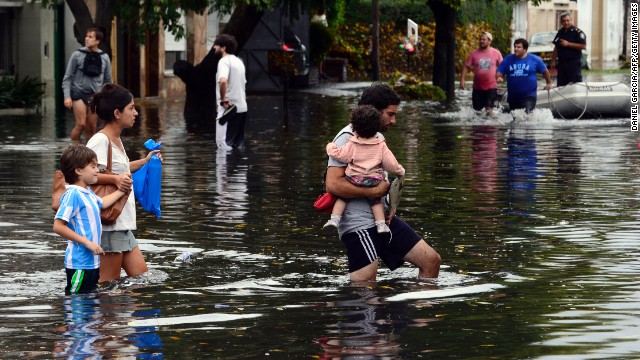
Deadly floods in Argentina
(CNN) -- Argentina's president declared three days of national mourning Wednesday after heavy rains claimed dozens of lives.
At least 48 people were killed in La Plata, outside Buenos Aires, officials said Wednesday.
"In 12 hours it has rained what it normally rains in the entire month of April," Santiago Martorelli, cabinet chief of the city, told the state-run Telam news agency. The rainfall in that period was 13 inches, he said.
"This storm is a catastrophe without precedent," Martorelli said.
Some 3,000 residents of La Plata have evacuated due to the rain, officials said.
Earlier, eight storm-related deaths were reported in Buenos Aires, the capital.
President Cristina Fernandez de Kirchner toured some of the most heavily damaged areas Wednesday evening.
"I have come to see what happened with this disaster," she said as she entered a flooded home, according to Telam. "I am not going to leave you alone."
Police patrols in the area will increase, she said, due to residents' concerns for their safety.
"People told me that they are afraid," she said, "beyond what they've lost."
Uruguay's senate approves same-sex marriage bill
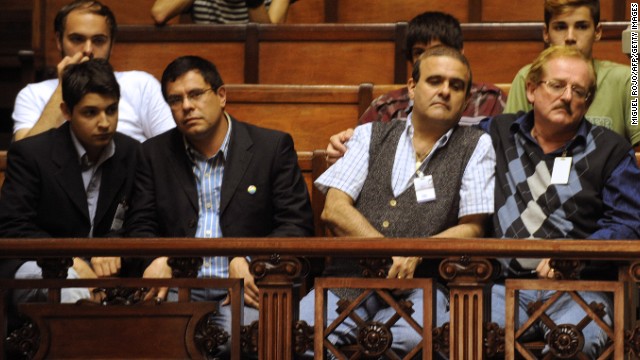
Montevideo, Uruguay (CNN) -- Uruguayan senators voted overwhelmingly in favor of a same-sex marriage measure Tuesday -- a key step that puts the South American nation on the path to becoming the 12th country to approve such a law.
Senators approved the marriage equality bill 23-8. Next week, lawmakers in the lower house, which approved a different version of the legislation late last year, are expected to vote on the senate's version.
If approved and signed by President Jose Mujica, who has indicated he supports the measure, the proposal would make Uruguay the second country in Latin America to legalize same-sex marriage. Neighboring Argentina legalized such marriages in 2010.
It's an issue that's sparked debate and impassioned demonstrations from supporters and opponents in many countries.
Legislators in France and the United Kingdom are among lawmakers worldwide weighing proposals to legalize same-sex marriage. In the United States, the question of same-sex marriage went before the Supreme Court last week, and justices are now deliberating over the matter.
The first same-sex couples walked down the aisle in the Netherlands in 2001. Since then, almost a dozen countries have passed laws allowing same-sex marriages and domestic partnerships, including Canada, South Africa, Belgium and Spain.
In Argentina, the push to legalize same-sex marriage met with fierce opposition from the Roman Catholic Church, with Cardinal Jorge Mario Bergoglio -- then the archbishop of Buenos Aires and now the pope -- engaging in a notorious war of words with the government over the issue.
In Uruguay, the church has taken a similar tack, with officials describing the measure as a harsh blow to the institutions of marriage and the family.
"Why make relative or devalue an institution that is already so injured, like the family, introducing deep modifications that are going to confuse more than clarify?" the Rev. Pablo Galimberti, bishop of Salto, wrote in a recent post on the website of the Uruguayan Bishops Council.
Uruguay's Broad Front, a coalition of left-wing political parties, backs the measure. On Tuesday, the group's president stressed that the proposed law change a civil institution and has nothing to do with the church.
"Here we are speaking about RIGHTS, with capital letters. Rights that were denied and repressed for a long time, and which a society that is trying to be modern and inclusive necessarily must recognize, to advance in equality," wrote Sen. Monica Xavier. "Rights that are inherent to people, that are not a legislative creation, but something that the law must recognize."
For years, it was rare to see gay rights issues gaining traction in Latin American countries.
Not anymore, Javier Corrales, a professor of political science at Amherst College in Massachusetts, told CNN in 2010.
"Latin America currently has some of the most gay-friendly cities in the developing world," said Corrales, who ranked cities' gay-friendliness in a book he co-edited, "The Politics of Sexuality in Latin America."
In 2009, Uruguay was the first Latin American country to allow same-sex couples to adopt children. It was also one the first Latin American countries to allow same-sex civil unions.
The measure approved by Uruguayan senators Tuesday removes the words "man" and "woman" from the country's civil code and replaces them with the word "spouse," CNN affiliate Teledoce reported.
Brazil police make 3rd arrest in rape of American woman
Sao Paulo, Brazil (CNN) -- Police in Brazil have arrested a third person in connection with the rape of an American woman on a minibus in Rio de Janeiro.
Carlos Armando Costa dos Santos was arrested Monday night, police said.
The woman boarded the minibus with another tourist in the Copacabana beach district in Rio de Janeiro early Saturday. Three men subsequently boarded the minibus and forced off all the other passengers, police said.
The woman was raped, and the other tourist, a man, was held captive and robbed, authorities said.
Their credit cards were used at multiple locations inside and outside of Rio de Janeiro over a span of hours, the police said in a statement.
According to Brazilian newspapers, the man was handcuffed and beaten, while the woman was repeatedly raped. The two were dumped in Itaborai, a city more than 30 miles (about 50 kilometers) away, after six hours, O Globo newspaper said.
Earlier, police arrested two men, both in their early 20s. They are Jonathan Foudakis de Souza and Wallace Aparecido Souza Silva.
The U.S. Consulate is in contact with the victim and is providing all appropriate consular assistance, said a State Department official, who did not want to be identified because he was not authorized to talk about the case
The rape highlights security concerns in the Brazilian city that will host matches in the 2014 World Cup and will put on the Summer Olympics two years later. '
As more women come forward saying they were victims of similar attacks, Rio de Janeiro's Civil Police Chief Martha Rocha issued a written apology. She also fired two police officers responsible for handling rape cases.
Rio has gone a long way toward cleaning up its image as one of Latin America's most violent cities. But Brazilian media already are drawing parallels between this attack and the infamous gang rape of a young woman on a bus in India.
A grisly crime surges into spotlight as Mexico shifts drug war strategy
(CNN) -- It was a staggering sight, even in a Mexican city that has seen its share of violence in recent years as drug-related crimes surged.
Seven bodies sat slumped in white plastic chairs placed near a central plaza in Uruapan, Mexico.
Local media reported messages were left behind, written on poster board and pinned to some of the victims' bodies with icepicks.
The men appeared to have been killed by gunfire, and investigators believe organized crime groups are to blame, Mexico's state-run Notimex news agency said. Investigators haven't provided details about who they suspect was responsible or why they targeted the men -- windshield washers and farm workers, according to Notimex.
Uruapan, a city of a quarter million people in the western state of Michoacan, made headlines in 2006 when members of a drug cartel -- La Familia Michoacana -- hurled five decapitated heads of rival gang members onto a dance floor there.
Subscribe to:
Posts (Atom)