Showing posts with label Catherine D. Show all posts

Wednesday, April 17, 2013

Colombian authorities row over Farc jail terms

Farc uniform Peace talks between the Farc and the government are continuing in Cuba
the rebel group Farc could escape jail terms should a peace deal be struck.
Eduardo Montealegre was reacting to earlier suggestions that Colombia could become a "rogue state" if an agreement allowed rebels to walk free.
Mr Montealegre said no Farc activists had yet been found guilty of crimes against humanity.
This week, thousands of people marched in support of the peace talks in Cuba.
The demonstrations, on Wednesday, came as Mr Montealegre announced that arrest orders against six Farc members had been suspended as part of the negotiations.
The activists are said to be part of Farc's negotiating team taking part in the talks aimed at ending five decades of violence.
'Inadmissible'
But Colombia's inspector-general, Alejandro Ordonez, spoke about "impunity" and said that the country would be in breach of international law if ever a peace deal allowed Farc members to walk free.
"It's inadmissible that those responsible for crimes against humanity, of war, genocides and displacements are not going to spend even a day in jail," he told reporters.
The attorney-general, however, said that kidnappings, the recruitment of under age "soldiers" and other crimes Farc members have already been found guilty of, were internationally recognised as human rights crimes but not as crimes against humanity.
He added that "transitional justice" was not the same as impunity.
Mr Montealegre maintained that there were other forms of punishment than jail and that a deal did not stand in the way of future investigations about crimes against humanity.
The negotiations launched last October in Norway by President Juan Manuel Santos are the first direct talks in a decade.
A month later, the meetings started in the Cuban capital, Havana.
But the issue is controversial with sectors of the armed forces and the police - who have fought Colombia's largest rebel group since the 1960s - and with supporters of former President Alvaro Uribe.
Official figures say at least 600,000 people have died and more than three million have been displaced by the conflict.
Chile ex-president launches election campaign

Chile's former president has launched her campaign for November's presidential election.
Michelle Bachelet kicked off the campaign on Saturday, saying she will use a second term to reform taxes and education and to fight Chile's huge income inequality.
"We must guarantee everyone a public education system that integrates them at all levels, ends profit and advances toward universal gratuity," she said.
"It's the desire of most Chileans."
Bachelet, 62, begins her campaign for the November 17 election as the front-runner.
The daughter of a general tortured to death for opposing General Augusto Pinochet's 1973 military coup, Bachelet herself was arrested along with her mother in 1975 and went into exile to Australia and the former East Germany.
She left office four years ago with soaring popularity ratings and was was unable to seek immediate re-election as  Chile's constitution bans consecutive terms.
But she conceded many issues were left unsolved during her presidency, key among them education reform and the sharp income inequality that has marred the country's economic growth.
"Combatting inequality is what gives us a purpose to be here," Bachelet said.
"It's the fine print that affects millions of consumers who are in debt. It's the salary gap between men and women and the inability of workers to negotiate collectively," the moderate Socialist Party member told a cheering crowd of about 5,000 people at the Caupolican theatre in downtown Santiago, the capital.

'Universal gratuity'
Bachelet, who has spent the last two years heading the UN agency for women, promised to push for tax reform so that "those who earn more, contribute more" to fund deep changes to Chile's troubled education system.
"We must guarantee everyone a public education system that integrates them at all levels, ends profit and advances toward universal gratuity," she said.
"It's the desire of most Chileans."
Student protests demanding free education marked the final years of her term and worsed during the administration of her conservative successor, Sebastian Pinera.
Pinera's popularity has plunged to the lowest level of any Chilean leader since the end of Pinochet's dictatorship in 1990.
Tens of thousands of students flooded the streets of Chile on Thursday to demand free education, showing the continuing strength of the student movement in an election year.
Bachelet's opponent from the conservative governing coalition is likely to be either Andres Allamand, former defence minister, or Laurence Golborne, the former public works minister who led the 2010 rescue of 33 miners trapped deep underground in the Atacama desert

Detainees, U.S. guards clash at Guantanamo Bay

By Greg Botelho and Barbara Starr, CNN
updated 5:34 AM EDT, Mon April 15, 2013
 
(CNN) -- Guantanamo Bay detainees wielding "improvised weapons" clashed Saturday with guards, an episode that occurred amid simmering tensions at the U.S. military base.
The U.S. guards responded by firing "four less-than-lethal rounds," the military's Joint Task Force Guantanamo said in a statement. No guards or detainees suffered "serious injuries" at the facility in Cuba.
The incident, which happened in Camp VI at the detention center, comes as some inmates have waged a weeks-long hunger strike in protest of their treatment, guards searching through Qurans and other issues.
Since 2002, the Guantanamo detention center -- where people have been held in a range of conditions, from communal living to lone, maximum-security cells -- has held people captured outside the United States in counterterrorism operations. As of November 2012, there were 166 detainees in the facility, according to a Carlos Warner, a U.S. lawyer representing some of those detainees, told CNN late last month detainees have become increasingly frustrated with "very dire, dire conditions" and their sense that the current legal process leaves them in limbo indefinitely.
"It leaves them with the prospect of the only way we leave Guantanamo is death," Warner said. "Unfortunately, I think the men are ready to embrace this."
Early Saturday, the commander of Joint Task Force Guantanamo ordered all inmates in Camp VI moved into individual cells. The reason, the military explained, was "to ensure the health and security of those detainees."
The clashes occurred while guards tried to move inmates.
Capt. Robert Durand, a Guantanamo spokesman, said the decision was made after detainees starting in February -- about the same time as latest hunger strike -- began obstructing surveillance cameras, windows and glass partitions. These actions, which Durand described as "non-compliant" and "unacceptable," made it difficult for guards to do "round-the-clock monitoring" throughout the facility.
"Suspending the detainees' communal living privileges was in response to a coordinated effort by detainees to create an unsafe situation and limit the guard force's observation," the military spokesman said.
"... The ability to continuously monitor detainees is the only way we can provide for their health and security. We should have gone in earlier."
Warner, the public defender for some Guantanamo detainees, has said frustrations have grown since a change in command last year, which was followed by a number of new policies.
The lack of action in closing Guantanamo Bay -- as President Barack Obama signed on to -- is furthering resentment that those held have no recourse or hope, the lawyer said.
"It was designed ... to be exactly what it is, a legal no man's land," Warner said. "Where there's one way in and the only way out is in a box."

Tuesday, April 2, 2013

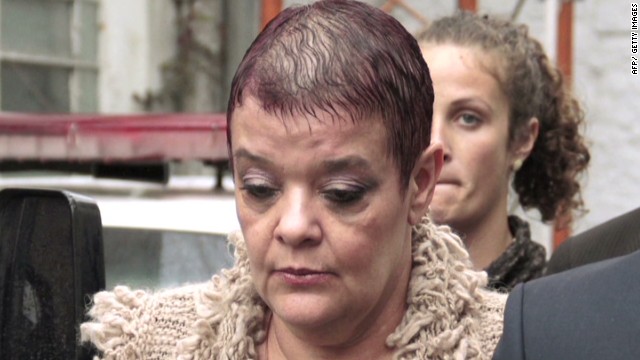
Brazilian doctor killed 7 patients to free up hospital beds, police say

Killing patients for hospital beds?

(CNN) -- A Brazilian doctor appeared in court for allegedly killing seven patients to free up hospital beds in the southeast city of Curitiba.
Virginia Helena Soares de Souza recruited a group of doctors to help administer lethal doses of anesthetics, sedatives and painkillers, according to authorities.
In addition, the group allegedly altered oxygen levels for patients, leading to deaths by asphyxiation, police said.
Seven other health care professionals have been charged in the case.
Prosecutors allege de Souza pulled the plug on victims against the wishes of patients and their families, and in so doing broke the law. She did that to free up beds in the ICU and clear up the "clutter" the patients were causing, according to police.
De Souza was arrested in February, but was later released until trial. Her court appearance Wednesday is part of mandated monthly appearances to avoid going back to jail.
Investigators say between 2006 and 2013, de Souza ordered medical professionals working under her at an intensive care unit to alter medication and oxygen levels.
In an interview with CNN affiliate TV Globo, Mario Lobato, the doctor tasked by the health ministry to investigate the case, said the number of deaths could be much higher.
He said his team is analyzing medical charts of more than 1,700 patients and interviewing more doctors.
During the seven years the incidents occurred, in cases where de Souza did not prescribe the drugs herself, she ordered other doctors to change mechanical ventilation devices, according to authorities. She allowed them access to medical records to issue prescriptions in her name, police said.
De Souza has pleaded not guilty.
Her lawyer, Elias Mattar Assad, said she will prove that her orders in the ICU were backed and justified by medical literature. Lobato, however, said some of the patients were awake and conscious moments before the drugs were administered.
CNN affiliate TV Record reported that the investigation began a year ago. In telephone recordings made with the consent of the justice department, de Souza ordered other medical doctors and employees to shut down some ventilation devices.
Euthanasia is considered a crime in Brazil